| The New York Optimist July 2008, Vol. 01: Issue 01 |
 |  |  |  |  |  |  |  |  |  |
Trilogue and Division
by Tola Brennan
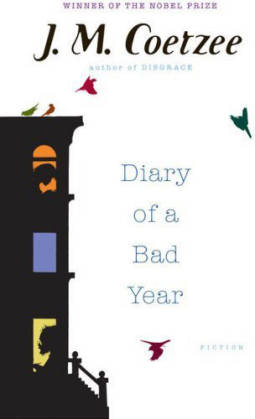
So, I finally finished Diary of a Bad Year. It is a great book. I've been reading it for months. No,
I haven't been savoring each page and then pondering, though I have for many of them. I first
saw it in the new releases rack at our friendly neighborhood Barnes & Noble. I love J.M.
Coeztee. I picked it up, read the back flap and left. I was with friends. A few days later, I came
back. A tradition was started. Every week or so, I would get my copy and find a corner upstairs.
Anyway, enough banter. Why is this book so amazing?
In all of Coetzee's books, his writing takes a certain dreamy but poignant quality. It manages to
be halcyon while speaking of subjects such as war, torture and suffering. The words carry a
gestalt which suggests but doesn't explicate ideas which aren't internally in the writing, or in the
narrative for that matter. It lets the reader imaginatively extrapolate while never reaching the
threshold of unsatisfying vagueness. It carries many of Dostoevsky’s merits, while not always
stressing the dismal. It affords the negative an equality with the positive.
Diary of a Bad Year is an account of a year in the life of Señor C. He gradually becomes
Coetzee when the narrator speaks of a book he wrote (Waiting for the Barbarians), which also
happens to be marvelous. Señor C. is commissioned to contribute to a project entitled Strong
Opinions. The project is a compilation of, as the name implies, strong opinions, on topics of the
writer's choosing, by various renowned authors worldwide. In the laundry room of his
apartment complex, Señor C notices an attractive woman in a red shift. He gradually
approaches her and requests that, due to his failing eyesight, she (for a salary of course)
become his typist.
The opinions and the story of their creation all get combined on one page. The top of each
page holds one of Señor C's opinions (ranging from politics and current affairs to philosophy
and literature, and is titled, for example, On the Origins of the State). The middle of the page
covers Señor C's relationship with the woman who does his typing. The bottom contains the
typist's opinions on the Señor.
The three stories all developing simultaneously require the reader to view the page distally. It
forces the reader to hold all three stories, or rather the same story from various viewpoints, all
at once. It releases the reader, in a sense, from a singular self. The three sequences of action
let the reader assume a multi-faceted conception of the narrative. The effect is at first severely
disconcerting but gradually become surprisingly pleasant.
Many of the opinions that Señor C takes are ones that I have considered, and it is always
pleasant to see one's views written more lucidly than the they phrase themselves in thought.
The ideas range from bitingly cynical to transcendently idealistic and ruminate very often on
the position of an inactive radical who ponders his own lack of brio.
by Tola Brennan
So, I finally finished Diary of a Bad Year. It is a great book. I've been reading it for months. No,
I haven't been savoring each page and then pondering, though I have for many of them. I first
saw it in the new releases rack at our friendly neighborhood Barnes & Noble. I love J.M.
Coeztee. I picked it up, read the back flap and left. I was with friends. A few days later, I came
back. A tradition was started. Every week or so, I would get my copy and find a corner upstairs.
Anyway, enough banter. Why is this book so amazing?
In all of Coetzee's books, his writing takes a certain dreamy but poignant quality. It manages to
be halcyon while speaking of subjects such as war, torture and suffering. The words carry a
gestalt which suggests but doesn't explicate ideas which aren't internally in the writing, or in the
narrative for that matter. It lets the reader imaginatively extrapolate while never reaching the
threshold of unsatisfying vagueness. It carries many of Dostoevsky’s merits, while not always
stressing the dismal. It affords the negative an equality with the positive.
Diary of a Bad Year is an account of a year in the life of Señor C. He gradually becomes
Coetzee when the narrator speaks of a book he wrote (Waiting for the Barbarians), which also
happens to be marvelous. Señor C. is commissioned to contribute to a project entitled Strong
Opinions. The project is a compilation of, as the name implies, strong opinions, on topics of the
writer's choosing, by various renowned authors worldwide. In the laundry room of his
apartment complex, Señor C notices an attractive woman in a red shift. He gradually
approaches her and requests that, due to his failing eyesight, she (for a salary of course)
become his typist.
The opinions and the story of their creation all get combined on one page. The top of each
page holds one of Señor C's opinions (ranging from politics and current affairs to philosophy
and literature, and is titled, for example, On the Origins of the State). The middle of the page
covers Señor C's relationship with the woman who does his typing. The bottom contains the
typist's opinions on the Señor.
The three stories all developing simultaneously require the reader to view the page distally. It
forces the reader to hold all three stories, or rather the same story from various viewpoints, all
at once. It releases the reader, in a sense, from a singular self. The three sequences of action
let the reader assume a multi-faceted conception of the narrative. The effect is at first severely
disconcerting but gradually become surprisingly pleasant.
Many of the opinions that Señor C takes are ones that I have considered, and it is always
pleasant to see one's views written more lucidly than the they phrase themselves in thought.
The ideas range from bitingly cynical to transcendently idealistic and ruminate very often on
the position of an inactive radical who ponders his own lack of brio.


| © MMVIII, Parent Productions LLC. All Rights Reserved. The New York Optimist & www.thenewyorkoptimist.com is a registered trademark of Parent Productions LLC. The New York Optimist is a registered service mark of Thenewyorkoptimist.com. The New York Optimist logo and original photos are a registered trademark of Parent Production LLC. |