| The New York Optimist November 2008 |
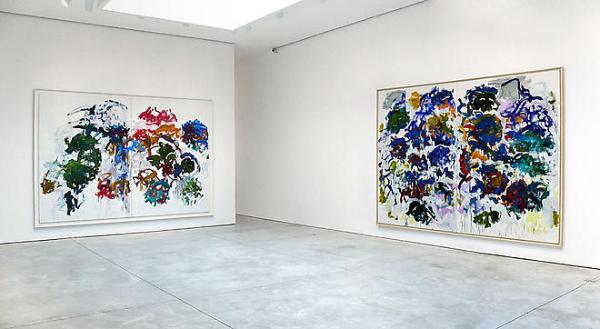
| November 6th Chelsea Gallery Art Crawl (with a stop on the 4th) by Stephan Fowlkes Sometimes, Chelsea doesn’t wait until Thursday to dazzle, shock and awe. And as a result it happens I find myself adventuring to the far West Side on days other than the Thursday art crawl. This week was one of those, as I found myself at the opening of Joan Mitchell’s “Sunflowers” at Cheim & Read on Tuesday November 4th. Although slightly shadowed by some election or other, there was still a good attendance, defined more by those interested in seeing something rare and exceptional than those looking for a cheap buzz. As a result, the reception was remarkably civilized, polite and respectful of each others’ personal space, even at the bar. C&R is a wonderful space to appreciate large work, and this show was exceptionally curated, properly respecting the work by not over-crowding the walls, showing only 17 works: paintings, pastels and etchings. Mitchell, who died in 1992, was often associated with the predominantly-male, macho Ab-Ex movement. However, the signature styles of the likes of Pollock, de Kooning and Hoffman, with whom she exhibited in the historic “Ninth Street Show” have comfortably settled into the annals of art history, there remains a freshness to Mitchell’s work, a contemporary value and validity. These “Sunflower” paintings, drawings and etchings from the late 60s through 1992 reveal a profound, passionate and deeply personal investigation and journey into the act of pure mark-making, departing from an observatory perspective of subject-matter as priority. And this is where any association with van Gogh’s famous sunflowers ends: “Unlike van Gogh, who in the Nineteenth Century could not yet imagine a wholly abstract art, Mitchell mobilized her artistic will to liberate the constituent elements of painting--line and color, composition and gesture--from their servitude to the fleeting appearances of the material world. In so doing, she makes good on the true of van Gogh’s practice: to hasten the stirrings of the unfettered spirit.” (C&R press release) The immediacy of her mark-making alludes to Action Painting, but there is a greater consciousness involved. Her compositions are as much about what she omits as what she chooses to depict. I find this particularly apparent in her triptych “Sunflowers” from 1990-91, where the left and right panels are composed of as few as ten brush strokes each. Yet like with Haiku, less is often more, and in this case it seems any additional brush strokes would simply cloud the composition. There is a clear and understated elegance in the end result, though the immediacy of the application is obvious and unavoidable. Yet there is a deliberate consciousness in her application of paint that removes her process from Direct or Action Painting; her masterful control of her strokes and marks becomes apparent in her awareness of composition--nothing accidental here. There is a vibrant liveliness to her compositions balanced with her dynamic palette that gives her sunflowers an amaranthine quality: the amaranth is a legendary undying flower. As dave Hickey states in the catalogue essay, “Mitchell’s sunflowers bloom for us in their glory, singly and in their floral banks. They reward us in the fullness of their moment, which is not much longer than the painter takes to re-imagine them, but they die dead. Mitchell insists that they do. They decay into weeds and sticks. They don’t swoon or wilt in elegiac tristesse, like Victorian maidens, or submit themselves willingly to ‘The Great Cycle of Life.’” She chooses to paint them in their full glory, immortalizing their peak beauty, yet not ignorant of the reality that ultimately they will meet their demise. So much can be read into the quality of her brushstroke--and though the end result is generally aesthetically pleasing, there can be deeper, darker qualities as Hickey mentions: “if we only seek sublimity, as many have, the idiosyncratic virtue of Mitchell’s paintings is transformed into a vice. We must pretend not to notice that, along with the joy, the grace and the ebullience, there is pettiness, panic, recrimination, jealousy and contempt, and naked self-hatred. The effect of feeling these small, sharp, human emotions while you’re looking at an abstract painting takes some getting used to, but they seem to be there in Mitchell’s paintings.” BUT, beyond all this profound ratiocination, Mitchell’s paintings are simply a pleasure to behold. They are fun, whimsical, dynamic, vibrant, alive. And like Miro’ s work, there is a childlike honesty in her mark-making which challenges intellectual platforms and returns to the sublime and sensual. Sunflowers Joan Mitchell at Cheim & Read 547 W. 25th Street November 4-December 20, 2008 |
| And for a little variety, here are a couple shows from the crawl I felt worthy of note: Adventures of a Reluctant Omnivore Mia Brownell at Artgate Gallery 547 W. 27th Street November 4-November 22, 2008 “Mia Brownell’s paintings uniquely layer Old Master realism with modern abstraction and conceptualism....By linking images of scientific models and the basic structures of life with images of the fruits that result from those structures, Brownell takes still life painting in diverse and conceptual new directions, richly revitalizing the genre,” (press release). |
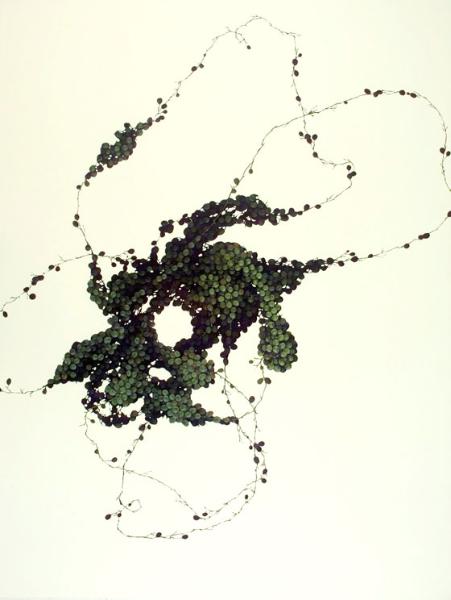
Mia Brownell
"Zymotic Tonic II" 2003
"Zymotic Tonic II" 2003
| Play Date Rosario Moore Arteaga at Venetia Kapernekas Gallery 526 W. 26th Street, suite 814 November 6-December 19, 2008 Rosario Moore Arteaga presents us with a variety of works, from cast miniature figures in silver, partially patenated to embossed monotypes to stuffed animals in interaction. “The work Una Sola Euforia is a miniscule silver sculpture depicting a loosely arranged mass of human bodies. At first glance the bodies appear to be entangled in the pleasure of an orgy. A closer observation reveals the scene of a massacre, in which Moore skillfully blends forms in playful juxtapositions between euphoria and pain. euphoria of destruction,” (press release). |


 |  |  |  |  |  |  |  |  |  |  |  |