 |  |  |  |  |  |  |  |  |  |  |  |

| The New York Optimist February 2009 |
February 12, 2009 Chelsea Art Crawl Review:
The Wonderful World of (Nevelson’s) Wood
by
Stephan Fowlkes
There is something seductive, alluring about wood as a sculptural material: wood has a history, a life even before it becomes a raw
material subject to the hands of a sculptor. Just as every tree is unique, so is every piece of wood; there are no two identical pieces.
And when working with found and discarded pieces of wood, each piece has a singular, inimitable history, and herein lies the beauty of
wood as a sculptor’s material. There is more of a dialogue between artist and material than the artist’s control over the material, as
would be the case with steel. The grain of the wood alludes to the tree the piece of wood came from, and can even inform as to the
conditions the tree grew in: climate, environment, even when the tree grew. A sheet of Cor-Ten steel never told such tales of its origin.
Furthermore, a discarded tabletop not only tells tales of the tree, but also of the life of the table, and of those to whom the table catered.
Nicks, dings, scratches, coffee stains all add to the character of a simple piece of wood; entropy becomes an ally, an asset as opposed
to a flaw. The older a piece of wood or furniture is, the more stories it can tell. On top of all this, there is also the vast variety of
different woods, with different colors, grain densities and patterns which can serve as a virtual palette for the artist, as well as the
stains, shellacs, urethanes, waxes and other finishes suitable to the medium, enabling even greater variety of surface finish.
When considering twentieth century sculptors who worked predominantly with wood, only a handful come to mind. At the top of my
list reside only two: Martin Puryear and Louise Nevelson. Both recently had beautiful shows in the past couple years: Nevelson at the
Jewish Museum in 2007, and Puryear at the MoMA in 2008, finally giving credit and due attention where it is overly deserved.
Although they share the same materials, there is a huge difference in their approach, intent, and aesthetic. Puryear’s work seems more
organic, manipulating the material to achieve a preconceived idea, as well as effectively paying a respect to the traditions associated with
woodworking: seamless construction, jointry, and wood as a material suitable to reach his desired ends. Nevelson, on the other hand,
worked much more intuitively, working with found materials she collected from the streets and factories, which she then manipulated
and assembled by any means necessary. Also, in some cases, Puryear emphasizes the “woodiness” of the material, with a focus on the
grain, or its pliable properties being central to the work whereas Nevelson predominantly painted her constructions monochromatically in
black, white, and later occasionally in gold. Yet in both of their oeuvres what stand out and distinguish the work from that of their
contemporaries are the unique qualities and properties afforded by their chosen material.
The Wonderful World of (Nevelson’s) Wood
by
Stephan Fowlkes
There is something seductive, alluring about wood as a sculptural material: wood has a history, a life even before it becomes a raw
material subject to the hands of a sculptor. Just as every tree is unique, so is every piece of wood; there are no two identical pieces.
And when working with found and discarded pieces of wood, each piece has a singular, inimitable history, and herein lies the beauty of
wood as a sculptor’s material. There is more of a dialogue between artist and material than the artist’s control over the material, as
would be the case with steel. The grain of the wood alludes to the tree the piece of wood came from, and can even inform as to the
conditions the tree grew in: climate, environment, even when the tree grew. A sheet of Cor-Ten steel never told such tales of its origin.
Furthermore, a discarded tabletop not only tells tales of the tree, but also of the life of the table, and of those to whom the table catered.
Nicks, dings, scratches, coffee stains all add to the character of a simple piece of wood; entropy becomes an ally, an asset as opposed
to a flaw. The older a piece of wood or furniture is, the more stories it can tell. On top of all this, there is also the vast variety of
different woods, with different colors, grain densities and patterns which can serve as a virtual palette for the artist, as well as the
stains, shellacs, urethanes, waxes and other finishes suitable to the medium, enabling even greater variety of surface finish.
When considering twentieth century sculptors who worked predominantly with wood, only a handful come to mind. At the top of my
list reside only two: Martin Puryear and Louise Nevelson. Both recently had beautiful shows in the past couple years: Nevelson at the
Jewish Museum in 2007, and Puryear at the MoMA in 2008, finally giving credit and due attention where it is overly deserved.
Although they share the same materials, there is a huge difference in their approach, intent, and aesthetic. Puryear’s work seems more
organic, manipulating the material to achieve a preconceived idea, as well as effectively paying a respect to the traditions associated with
woodworking: seamless construction, jointry, and wood as a material suitable to reach his desired ends. Nevelson, on the other hand,
worked much more intuitively, working with found materials she collected from the streets and factories, which she then manipulated
and assembled by any means necessary. Also, in some cases, Puryear emphasizes the “woodiness” of the material, with a focus on the
grain, or its pliable properties being central to the work whereas Nevelson predominantly painted her constructions monochromatically in
black, white, and later occasionally in gold. Yet in both of their oeuvres what stand out and distinguish the work from that of their
contemporaries are the unique qualities and properties afforded by their chosen material.
Louise Nevelson was born in Russia in 1899 and emigrated to the U.S. in 1905. Over the next 83 years,
Nevelson witnessed a majority of the great events of the twentieth century, but more importantly, she
would be exposed to the movements in the world of art through Cubism, Dada, Surrealism,
Constructivism, Abstract Expression, Minimalism, Conceptualism, feminism, and installation art--all of
which informed the evolution of her work, intentionally or not. Nevelson was not, however, just
drawing from these movements, but was an integral player in defining the latter movements, starting in
the midst of the Ab Ex movement, when in 1959, at the age of sixty, she was invited to participate in
“Sixteen Americans,” the pivotal show of emerging contemporary art at the MoMA. She was put
alongside the likes of Rauschenberg, Johns, Kelly, and Stella who was only 23 at the time. She was the
only one of the sixteen given an entire room, where she unveiled her work in white for the first time to
the public with “Dawn’s Wedding Feast,” an installation of many medium- and large-scale works in her
signature style. She is also largely credited as being one of the pioneers of installation art.
In the forties, when the sculptors such as David Smith, Anthony Caro and Seymour Lipton were turning
the focus of sculpture toward metal which was readily available, indicative of the industrial revolution
and the world wars, Nevelson chose wood as her primary medium. Possibly influenced by her father
who ran a junkyard in Maine, she was a forager and a pack-rat; she collected whatever pieces of wood
she could from the streets and factories---anywhere she could, and she amassed these odds and ends--
machine part molds, spools, orbs, moulding, chairs and chair parts, railings, broom handles, table legs,
type-set drawers, shoe molds, etc.--arranging them, assembling them filling boxes with them, stacking
these boxes into entire environments, painting them monochromatically, separating the forms from their
prior purposes, creating a rich vocabulary of intentional forms brought into a new language.
“Louise Nevelson: Dawns and Dusks” at Pace Wildenstein is a good survey of such works spanning
four decades from the fifties through the eighties, mostly black assemblages, with a few natural,
unpainted pieces for a nice variety. The walls are painted a dark grey to set the mood for the black free-
standing box assemblage/ constructions and wall pieces. Each piece is elaborate enough to get lost in
the intricacies of the systems she creates, while keeping a confident sense of intuition and chance in
play. If you missed the show at the Jewish Museum, this is a definite must-see! Open through March
14th.
Louise Nevelson: Dawns and Dusks
Pace Wildenstein
534 W. 25th Street
February 13-March 14, 2009
Nevelson witnessed a majority of the great events of the twentieth century, but more importantly, she
would be exposed to the movements in the world of art through Cubism, Dada, Surrealism,
Constructivism, Abstract Expression, Minimalism, Conceptualism, feminism, and installation art--all of
which informed the evolution of her work, intentionally or not. Nevelson was not, however, just
drawing from these movements, but was an integral player in defining the latter movements, starting in
the midst of the Ab Ex movement, when in 1959, at the age of sixty, she was invited to participate in
“Sixteen Americans,” the pivotal show of emerging contemporary art at the MoMA. She was put
alongside the likes of Rauschenberg, Johns, Kelly, and Stella who was only 23 at the time. She was the
only one of the sixteen given an entire room, where she unveiled her work in white for the first time to
the public with “Dawn’s Wedding Feast,” an installation of many medium- and large-scale works in her
signature style. She is also largely credited as being one of the pioneers of installation art.
In the forties, when the sculptors such as David Smith, Anthony Caro and Seymour Lipton were turning
the focus of sculpture toward metal which was readily available, indicative of the industrial revolution
and the world wars, Nevelson chose wood as her primary medium. Possibly influenced by her father
who ran a junkyard in Maine, she was a forager and a pack-rat; she collected whatever pieces of wood
she could from the streets and factories---anywhere she could, and she amassed these odds and ends--
machine part molds, spools, orbs, moulding, chairs and chair parts, railings, broom handles, table legs,
type-set drawers, shoe molds, etc.--arranging them, assembling them filling boxes with them, stacking
these boxes into entire environments, painting them monochromatically, separating the forms from their
prior purposes, creating a rich vocabulary of intentional forms brought into a new language.
“Louise Nevelson: Dawns and Dusks” at Pace Wildenstein is a good survey of such works spanning
four decades from the fifties through the eighties, mostly black assemblages, with a few natural,
unpainted pieces for a nice variety. The walls are painted a dark grey to set the mood for the black free-
standing box assemblage/ constructions and wall pieces. Each piece is elaborate enough to get lost in
the intricacies of the systems she creates, while keeping a confident sense of intuition and chance in
play. If you missed the show at the Jewish Museum, this is a definite must-see! Open through March
14th.
Louise Nevelson: Dawns and Dusks
Pace Wildenstein
534 W. 25th Street
February 13-March 14, 2009

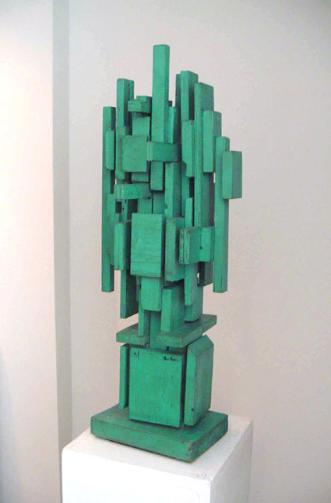



NEW YORK, February 4, 2009—PaceWildenstein is pleased to present a selection of works from
four decades by Louise Nevelson. Nevelson’s formalist achievement is revealed in more than thirty
works from the 1950s through the 1980s. The exhibition includes large-scale painted black
monochrome wood wall reliefs
and free-standing sculptures
ranging in size up to nearly 10
feet by 12 feet, and
mixed-media collages on paper
and board, which incorporate
materials such as wood, paper,
newsprint, paint, vinyl, metal,
and other found objects. Louise
Nevelson: Dawns and Dusks
will be on view at
PaceWildenstein, 534 West 25th
Street from February 13
through March 14, 2009. An
opening reception will be held on
Thursday, February 12th
from 6-8 pm.
and free-standing sculptures
ranging in size up to nearly 10
feet by 12 feet, and
mixed-media collages on paper
and board, which incorporate
materials such as wood, paper,
newsprint, paint, vinyl, metal,
and other found objects. Louise
Nevelson: Dawns and Dusks
will be on view at
PaceWildenstein, 534 West 25th
Street from February 13
through March 14, 2009. An
opening reception will be held on
Thursday, February 12th
from 6-8 pm.