Then at Winston Wachter, the cityscape paintings of Parisian landmarks by Peter Waite are monumental both in scale and in
subject matter. “Tower/Paris” (2009) an 8’ x 6’ canvas, offers a fantastic perspective of the Eiffel Tower; “Arch/Paris” (2009) is 10’x 8’
with a head-on view of L’Arc De Triomphe,
yet the power of the works comes from the fact that these scenes are void of all human presence--no pedestrians, no traffic, no signs
of life. These paintings are as much about what isn’t there as what is; the usual way we see these iconic places generally involves a
lot of external sensory stimulus: movement, traffic, crowds of tourists, urban noise. By stripping all this away, Waite manages to alter
the presence,emphasize the monumentality, and inflect a certain serenity to what is otherwise a frenetic atmosphere at these urban
landmarks.
Other works include a Metro passage, L’Opera, the Loeuvre, all empty, pure architecture and are emphasized by Waite’s painterly
technique where the drips inform the perspective, like on an architectural drawing. The crowds at the opening filled these vacant
spaces, becoming the characters within the paintings, adding the human element, bringing them to life, back to reality.
subject matter. “Tower/Paris” (2009) an 8’ x 6’ canvas, offers a fantastic perspective of the Eiffel Tower; “Arch/Paris” (2009) is 10’x 8’
with a head-on view of L’Arc De Triomphe,
yet the power of the works comes from the fact that these scenes are void of all human presence--no pedestrians, no traffic, no signs
of life. These paintings are as much about what isn’t there as what is; the usual way we see these iconic places generally involves a
lot of external sensory stimulus: movement, traffic, crowds of tourists, urban noise. By stripping all this away, Waite manages to alter
the presence,emphasize the monumentality, and inflect a certain serenity to what is otherwise a frenetic atmosphere at these urban
landmarks.
Other works include a Metro passage, L’Opera, the Loeuvre, all empty, pure architecture and are emphasized by Waite’s painterly
technique where the drips inform the perspective, like on an architectural drawing. The crowds at the opening filled these vacant
spaces, becoming the characters within the paintings, adding the human element, bringing them to life, back to reality.
| The New York Optimist |
| © MMVIII, All Rights Reserved. The New York Optimist & www.thenewyorkoptimist.com is a registered trademark of The New York Optimist is a registered service mark of Thenewyorkoptimist.com. The New York Optimist logo and original photos are a registered trademark of www.thenewyorkoptimist.com |
 |  |  |  |  |  |  |  |  |  |  |  |
January 21-28, 2010 Gallery Art Crawl
Chelsea, Soho and Williamsburg
by Stephan Fowlkes
And for something altogether different, I’m going to talk about paintings! This week we departed from the previous, dynamic,
expressive, gestural and immediate painting styles we’d seen (think Eddie Martinez) for more direct, content- and image-laden
works. Here, the figurative and realist works are imbued with both narrative and place, with technique taking a back seat to content
and atmosphere, to varying degrees.
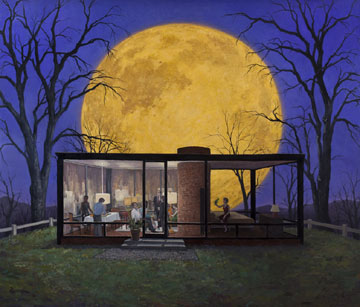
In “Imitation of Life” KK Kozik investigates the cinema of life through elaborately conceived “scenes” or “stills” from some imagined
cinematic scenario. Each of Kozik’s large canvases refer to some greater story line, where the viewer is limited to but one frame of
the larger situation taking place. In some cases, several of the paintings can be seen as sequential sections of a larger story: “A
World Apart” (2009) presents us with two figures intimately chatting over an illuminated globe, as if at a cocktail party, though their
setting happens to be in the woods;
in “Untitled” (2009), possibly the same two characters are now indoors, again alone, possibly after the cocktail party, where the
woman is blowing out a candle, indicating it is time to leave the table for something else; “Nightcap” (2009) also shows two figures
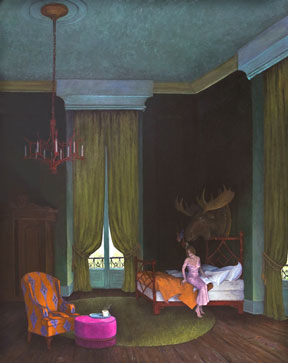
after some event and could also be scene three; the closing scene could be “Black Coffee” (2009) where a woman sits alone on her
bed the next morning, staring at her fresh cup of coffee across the room--the intensity of her gaze, longing, and the dynamic
between her and the coffee almost physical--emphasizes the absence of the gentleman.
One of the great qualities of these paintings is the “set design.” The atmospheres, whether indoor or outdoor are charged and
verge on the surreal. From the book case-lined walls in “Cat’s Eye III” (2009) to the world map in “Hotline” (2008) to the wallpaper in
“Trees Frieze” (2009), Kozik creates lavish environments for the story to unfold.
Painting is the means to achieve the story Kozik wishes to convey. They are meticulous and vibrant, atmospheric, windows into a
world of Kozik’s imagination--and what a glamorous--if not somewhat unsettling--world it is.
Chelsea, Soho and Williamsburg
by Stephan Fowlkes
And for something altogether different, I’m going to talk about paintings! This week we departed from the previous, dynamic,
expressive, gestural and immediate painting styles we’d seen (think Eddie Martinez) for more direct, content- and image-laden
works. Here, the figurative and realist works are imbued with both narrative and place, with technique taking a back seat to content
and atmosphere, to varying degrees.
In “Imitation of Life” KK Kozik investigates the cinema of life through elaborately conceived “scenes” or “stills” from some imagined
cinematic scenario. Each of Kozik’s large canvases refer to some greater story line, where the viewer is limited to but one frame of
the larger situation taking place. In some cases, several of the paintings can be seen as sequential sections of a larger story: “A
World Apart” (2009) presents us with two figures intimately chatting over an illuminated globe, as if at a cocktail party, though their
setting happens to be in the woods;
in “Untitled” (2009), possibly the same two characters are now indoors, again alone, possibly after the cocktail party, where the
woman is blowing out a candle, indicating it is time to leave the table for something else; “Nightcap” (2009) also shows two figures
after some event and could also be scene three; the closing scene could be “Black Coffee” (2009) where a woman sits alone on her
bed the next morning, staring at her fresh cup of coffee across the room--the intensity of her gaze, longing, and the dynamic
between her and the coffee almost physical--emphasizes the absence of the gentleman.
One of the great qualities of these paintings is the “set design.” The atmospheres, whether indoor or outdoor are charged and
verge on the surreal. From the book case-lined walls in “Cat’s Eye III” (2009) to the world map in “Hotline” (2008) to the wallpaper in
“Trees Frieze” (2009), Kozik creates lavish environments for the story to unfold.
Painting is the means to achieve the story Kozik wishes to convey. They are meticulous and vibrant, atmospheric, windows into a
world of Kozik’s imagination--and what a glamorous--if not somewhat unsettling--world it is.


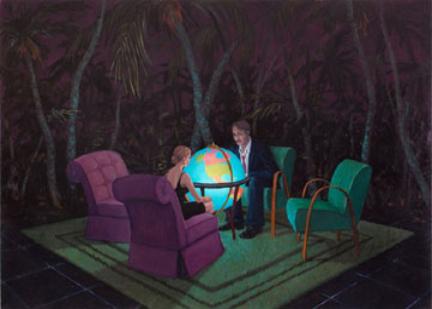
| A WORLD APART, 2009 oil on linen 30 x 42 inches |


SHARE:

| BLACK COFFEE, 2009 oil on linen 72 x 57 inches |
| BIRD, 2010 oil on linen 62 x 73 inches |
| KK Kozik: Imitation of Life January 21-February 20, 2010 Black & White Gallery 636 W. 28th Street |

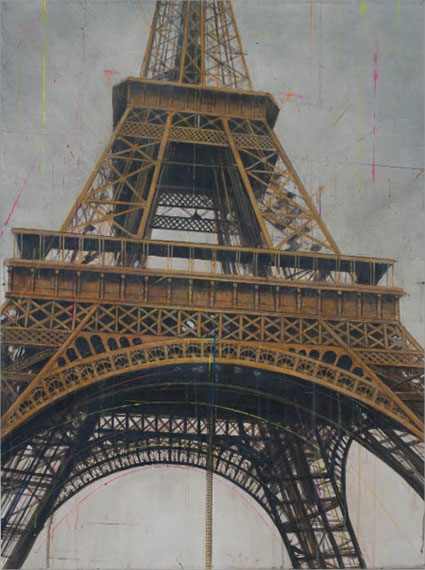
| Tower/Paris 2009Acrylic on panel 32 x 24 inches |
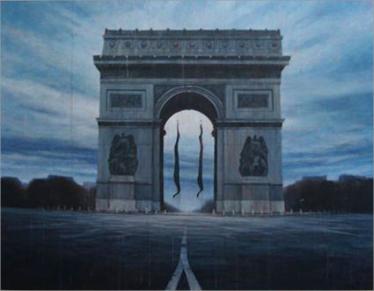
| Arch/Paris 2008Acrylic on panels96 x 120 inches |
| Peter Waite: Paintings/Paris January 21-February 27, 2010 Winston Wachter Fine Art 530 W. 25th Street |
With exquisite respect for and manipulation of the raw materials with which she works, Sook Jin Jo transforms the gallery space into a
shrine of sorts. Covering a majority of the floor with an endless array of chairs in various states of decay--collected from the streets
over the past ten years--all facing the back wall, Sook elicits a certain sense of place, referential of academic lecture halls, theaters,
places of worship--especially with the dramatic, dim lighting--all with equal grace and balance. The weathered and worn state of
most chairs adds a sense of nostalgia, each seat telling its own story. The fact that all the legs of the chairs are cut off, there is a
very East-meets-West notion: sitting on the floor, yet in a chair. Each seat is as unique as the person who sat in it once upon a time,
the entropic patina particular to each, revealing years if not decades of stories untold. As to the great wall piece, well I suggest you
go see it for yourself. It well makes it worth a trip to Soho.
shrine of sorts. Covering a majority of the floor with an endless array of chairs in various states of decay--collected from the streets
over the past ten years--all facing the back wall, Sook elicits a certain sense of place, referential of academic lecture halls, theaters,
places of worship--especially with the dramatic, dim lighting--all with equal grace and balance. The weathered and worn state of
most chairs adds a sense of nostalgia, each seat telling its own story. The fact that all the legs of the chairs are cut off, there is a
very East-meets-West notion: sitting on the floor, yet in a chair. Each seat is as unique as the person who sat in it once upon a time,
the entropic patina particular to each, revealing years if not decades of stories untold. As to the great wall piece, well I suggest you
go see it for yourself. It well makes it worth a trip to Soho.
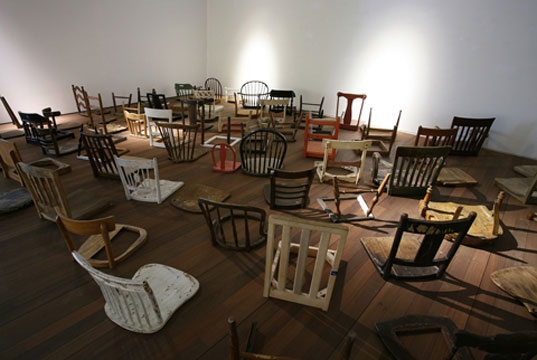
| SOOK JIN JO Chairs - 2000-2009 aproximately 200 chairs collected from 2000-2009 in New York: dimensions vary |
| Sook Jin Jo January 16-February 20, 2010 OK Harris 383 West Broadway |
Also, be sure to check out the new group show at NurtureArt. “Eternal Return” features six artists and was curated by Christine
Spangler and Tyler Cambell Wriston. There is an amazing site-specific installation constructed entirely out of coffee stir sticks--about
30,000--woven and held together solely by tension rising from floor to the skylight in the ceiling, by Jonathan Brilliant. Thomas
Lendvai created an inter-room installation in his signature style, heavy mathematics translated to simple, everyday materials, in this
case, two-by-fours, involving circles and elipses transversing the gallery wall. The calculation and exactitude is not immediately
apparent yet exists, each 2x4 cut to a particular, different complex angle to collectively, visually signify cylinders skewed through the
wall, through space, pure geometry translated to a visual manifestation. Also of note was a large charcoal, gestural wall drawing by
Judith Braun loosely referencing the Phoenix rising out of the ashes, over and over, directly referring to the theme of the show,
Nietzsche’s “eternal return” or “eternal reoccurrence” (too complex to describe here). The six artists successfully present a diverse
ways of addressing the notion of repetition through both their processes and the end results
Spangler and Tyler Cambell Wriston. There is an amazing site-specific installation constructed entirely out of coffee stir sticks--about
30,000--woven and held together solely by tension rising from floor to the skylight in the ceiling, by Jonathan Brilliant. Thomas
Lendvai created an inter-room installation in his signature style, heavy mathematics translated to simple, everyday materials, in this
case, two-by-fours, involving circles and elipses transversing the gallery wall. The calculation and exactitude is not immediately
apparent yet exists, each 2x4 cut to a particular, different complex angle to collectively, visually signify cylinders skewed through the
wall, through space, pure geometry translated to a visual manifestation. Also of note was a large charcoal, gestural wall drawing by
Judith Braun loosely referencing the Phoenix rising out of the ashes, over and over, directly referring to the theme of the show,
Nietzsche’s “eternal return” or “eternal reoccurrence” (too complex to describe here). The six artists successfully present a diverse
ways of addressing the notion of repetition through both their processes and the end results
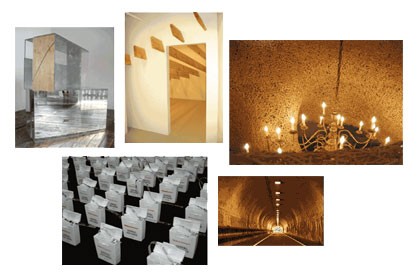
| Eternal Return January 22-February 28, 2010 Nurture Art 910 Grand Street, Brooklyn |
| Stephan Fowlkes |
