| The New York Optimist |
 |  |  |  |  |  |  |  |  |  |  |  |


| © MMIX, The New York Optimist. All Rights Reserved. The New York Optimist & www.thenewyorkoptimist.com is a registered trademark of The New York Optimist. The New York Optimist is a registered service mark of Thenewyorkoptimist.com. The New York Optimist logo and original photos are a registered trademark of The New York Optimist . All other photos are property of the advertiser. And are rightfully protected under their copyright protections. |


SHARE


“Waking up on the Valley Floor”.
When I first walked into the Galerie im Taxispalais, Galerie des Landes Tirol in 2009, it
appeared like many contemporary exhibition spaces housed in centuries old European
architecture; Vaulted archways covered over with dry wall creating modular interiors
quadrated off with glass and metal framing with interlocking wood elements to retain a
human touch.
I looked to the left and it appeared that something crashed through the ceiling from the
floor above suspended in space moments before it hits the floor by the remaining chards
of the same materials that keep the building intact.
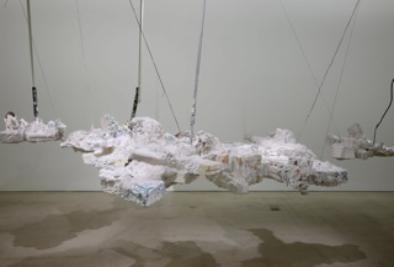
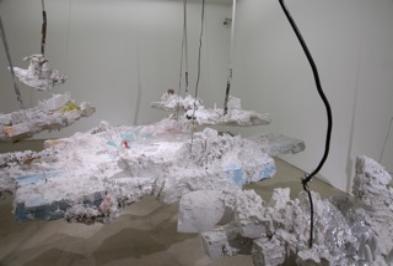
Sure enough what I was looking at was re-enforced plaster with chicken wire, aluminum
studs, insulation foam and other hardware with the glitter of bright coloured foil engulfed
within its girth.
But this was not the debris of a structural mishap or the work of a neo anarchist
specializing in deconstructive methods enforced upon the interiors of contemporary
cultural venues.
This was the work of Stefan Löffelhardt, an Austrian artist that would have gone
unbeknownst to me had it not been for the squabble I had with another artist for whom I
was in town to install their work.
When I first walked into the Galerie im Taxispalais, Galerie des Landes Tirol in 2009, it
appeared like many contemporary exhibition spaces housed in centuries old European
architecture; Vaulted archways covered over with dry wall creating modular interiors
quadrated off with glass and metal framing with interlocking wood elements to retain a
human touch.
I looked to the left and it appeared that something crashed through the ceiling from the
floor above suspended in space moments before it hits the floor by the remaining chards
of the same materials that keep the building intact.
Sure enough what I was looking at was re-enforced plaster with chicken wire, aluminum
studs, insulation foam and other hardware with the glitter of bright coloured foil engulfed
within its girth.
But this was not the debris of a structural mishap or the work of a neo anarchist
specializing in deconstructive methods enforced upon the interiors of contemporary
cultural venues.
This was the work of Stefan Löffelhardt, an Austrian artist that would have gone
unbeknownst to me had it not been for the squabble I had with another artist for whom I
was in town to install their work.
The bar was raised, or in this case the ceiling dropped in order to create an arena of smart
play while laying down the trip wires for lazy lookers like myself.
So blatant were the materials and their aggressive coalescence challenging the interior
architecture of the Taxispalais, it rendered a meltdown of current theories involving the
“installation as an enhancement” to its hosts’ space.
play while laying down the trip wires for lazy lookers like myself.
So blatant were the materials and their aggressive coalescence challenging the interior
architecture of the Taxispalais, it rendered a meltdown of current theories involving the
“installation as an enhancement” to its hosts’ space.
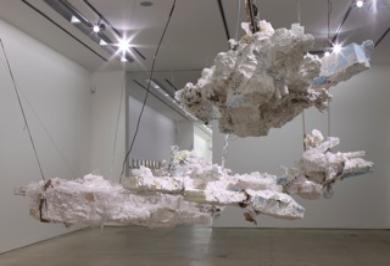
| Alexander Viscio Presents Waking Up On The Valley Floor |
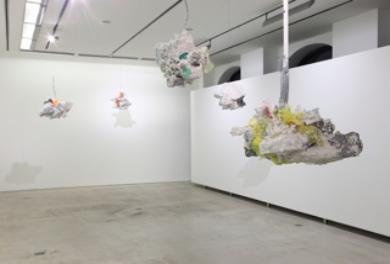


Despite its bulk the work dares to come off as cloud formations of colliding mass, visceral
accumulating systems whose mutation arise from its course patterns through out the
space. But these are clouds not the rollicking cumulous type that seem to jolly up upon
each other in blue skies. These are the nemesis types that decoy you into close
approximation to their abrasive terrain of colliding form as you steer through the channels
between them.
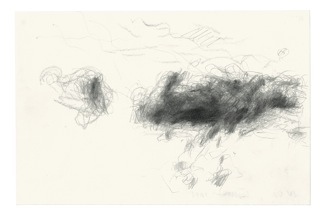
Beyond the haywire of interchanging form and space lies an inherent quality of drawing that
is fundamental in most creative processes. What may be dismissed as merely a whimsical
assemblage of ordinary detritus and other usual suspects of materials found amongst
construction sites, is a lexicon of Mr. Löffelhardt’s acute sensitivity to the mute and
invisible qualities of innate materials deliberately applied into an efficient display that
assaults the space it was invited to, welcome the unruly yet refreshing quest.
accumulating systems whose mutation arise from its course patterns through out the
space. But these are clouds not the rollicking cumulous type that seem to jolly up upon
each other in blue skies. These are the nemesis types that decoy you into close
approximation to their abrasive terrain of colliding form as you steer through the channels
between them.
Beyond the haywire of interchanging form and space lies an inherent quality of drawing that
is fundamental in most creative processes. What may be dismissed as merely a whimsical
assemblage of ordinary detritus and other usual suspects of materials found amongst
construction sites, is a lexicon of Mr. Löffelhardt’s acute sensitivity to the mute and
invisible qualities of innate materials deliberately applied into an efficient display that
assaults the space it was invited to, welcome the unruly yet refreshing quest.
Even the apparatus (bailing wire and corner bead), assigned to connect the work to the venue
in a nonchalant manner, is an inherent component that articulates the drawing element and
resolution of form in the lyricism of his language.
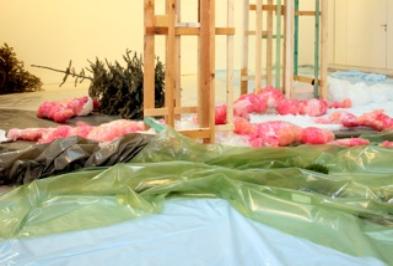
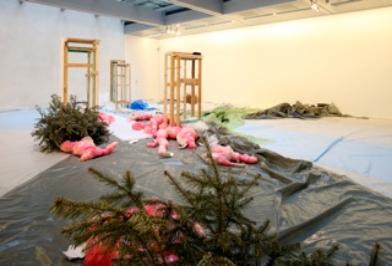
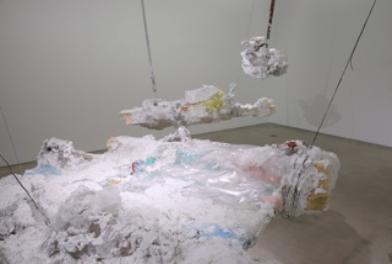
Traversing down to the lower floor one sees what looks like a landfill of discarded/dis-
associated materials. Plastic tarps, large sheets of thin metallic foil, pink bubble wrap, simply
constructed wood pedestals and Christmas trees are strewed about with the conspicuous
randomness of IEDs, offering another landscape of entrapment that impels us to explore the
terrain with vigilance so as not to disturb the tranquility of the abandoned.
This space is the tallest reaching over 4 meters to its glass ceiling that hovers over the entire
floor space running roughly 10 by 10 meters. It floods the materials on the floor with ample
natural light creating a cavernous environment telltale to the show’s title, “The Valley Floor”.
This makes Mr. Löffelhardt’s handling of this space even more audacious. He deliberately
chooses to fill the space simply by covering the floor for the most part with flat yet rippling
surfaces coercing the viewer to gingerly traverse through the space making certain to leave
nothing undiscovered lest be caught unacquainted in foreign territory.
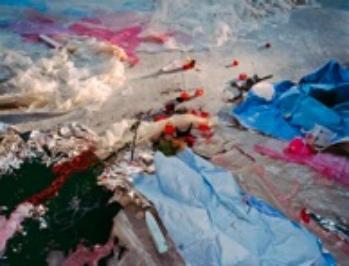
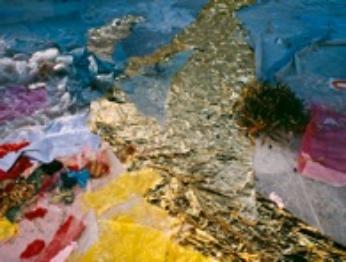
After having ducked under, slipped sideways to and stepped over at small intervals, all the
square meters of the artist’s visceral re-formations, we ascend to a smaller gallery upstairs
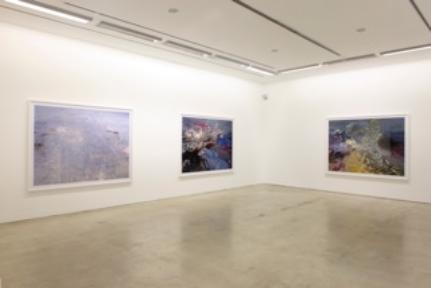
containing a suite of large photographs of what appears to be the undulations of the sea
flowing in and swaying out from shore, shot at an angle used by oceanographers studying the
effects of pollution collected in the tide.
In effect these are scrupulously arranged detailed compositions for the camera made from the
same palette found through out the exhibition coming back around to offer another focal point
of what the artist sees and wants to share.
With the same deftness in how he fills space narrow, wide and high, Mr. Löffelhardt frames his
composites illustrating the ebb and flow of his materials applying unnatural light sources to
achieve their optimum innate complexities. At 156 x 204cm this format employs the vista
essential for the retinal/mental transition from seashore to synthetic landscape.
Here the work is certainly greater than the sum of its parts evoking the phenomena of the
evolutionary process of discovery to occur. One I just don’t experience enough of when paying
money to see contemporary art.
The artist instates that his is a sure crafted, well-fortified language, a product of the arduous
task of meticulous investigation and the insistent application of his vision.
Surely, this was not a quick in and out show to take in if you had someplace else to be right
after. It asks for time. It challenges you to look and excavate the under layers and complexities
of form reforming with precarious balance with the space in ways that one isn’t accustomed to
experiencing in most spectacle driven, media pimped exhibitions.
Mr. Löffelhardt allured the sublime to permeate my need for spectacle and splash and opened
up the floodgates of a sensorial storm up rooting my lazy ways of looking and my need for
speed.
It had been nearly three years since I saw “The Valley Floor”. I went back to the Taxispalaise
last year, this time to install the work of yet another Austrian artist. I told the director I had seen
this “amazingly courageous show 3 years ago that was an invigorating wake up call”. She
immediately knew the artist I was referring to and stated that it was her first show here as the
new director and that I might have been the only one in Innsbruck to like it.
No doubt the sign of a leader with vision when Beate Ermacora the newly ordained director of
the Galerie im Taxispalais, Galerie des Landes Tirol at the time, takes such a risk in her
inaugural curatorial assignment that places her tenure immediately upon the indiscretions of an
impatient board of trustees.
Blue Skies,
Alexander Viscio.
http://alexanderviscio.com/
http://strangepositioningsystems.org
in a nonchalant manner, is an inherent component that articulates the drawing element and
resolution of form in the lyricism of his language.
Traversing down to the lower floor one sees what looks like a landfill of discarded/dis-
associated materials. Plastic tarps, large sheets of thin metallic foil, pink bubble wrap, simply
constructed wood pedestals and Christmas trees are strewed about with the conspicuous
randomness of IEDs, offering another landscape of entrapment that impels us to explore the
terrain with vigilance so as not to disturb the tranquility of the abandoned.
This space is the tallest reaching over 4 meters to its glass ceiling that hovers over the entire
floor space running roughly 10 by 10 meters. It floods the materials on the floor with ample
natural light creating a cavernous environment telltale to the show’s title, “The Valley Floor”.
This makes Mr. Löffelhardt’s handling of this space even more audacious. He deliberately
chooses to fill the space simply by covering the floor for the most part with flat yet rippling
surfaces coercing the viewer to gingerly traverse through the space making certain to leave
nothing undiscovered lest be caught unacquainted in foreign territory.
After having ducked under, slipped sideways to and stepped over at small intervals, all the
square meters of the artist’s visceral re-formations, we ascend to a smaller gallery upstairs
containing a suite of large photographs of what appears to be the undulations of the sea
flowing in and swaying out from shore, shot at an angle used by oceanographers studying the
effects of pollution collected in the tide.
In effect these are scrupulously arranged detailed compositions for the camera made from the
same palette found through out the exhibition coming back around to offer another focal point
of what the artist sees and wants to share.
With the same deftness in how he fills space narrow, wide and high, Mr. Löffelhardt frames his
composites illustrating the ebb and flow of his materials applying unnatural light sources to
achieve their optimum innate complexities. At 156 x 204cm this format employs the vista
essential for the retinal/mental transition from seashore to synthetic landscape.
Here the work is certainly greater than the sum of its parts evoking the phenomena of the
evolutionary process of discovery to occur. One I just don’t experience enough of when paying
money to see contemporary art.
The artist instates that his is a sure crafted, well-fortified language, a product of the arduous
task of meticulous investigation and the insistent application of his vision.
Surely, this was not a quick in and out show to take in if you had someplace else to be right
after. It asks for time. It challenges you to look and excavate the under layers and complexities
of form reforming with precarious balance with the space in ways that one isn’t accustomed to
experiencing in most spectacle driven, media pimped exhibitions.
Mr. Löffelhardt allured the sublime to permeate my need for spectacle and splash and opened
up the floodgates of a sensorial storm up rooting my lazy ways of looking and my need for
speed.
It had been nearly three years since I saw “The Valley Floor”. I went back to the Taxispalaise
last year, this time to install the work of yet another Austrian artist. I told the director I had seen
this “amazingly courageous show 3 years ago that was an invigorating wake up call”. She
immediately knew the artist I was referring to and stated that it was her first show here as the
new director and that I might have been the only one in Innsbruck to like it.
No doubt the sign of a leader with vision when Beate Ermacora the newly ordained director of
the Galerie im Taxispalais, Galerie des Landes Tirol at the time, takes such a risk in her
inaugural curatorial assignment that places her tenure immediately upon the indiscretions of an
impatient board of trustees.
Blue Skies,
Alexander Viscio.
http://alexanderviscio.com/
http://strangepositioningsystems.org